@Amnesic
Conducted: 2025-12-18
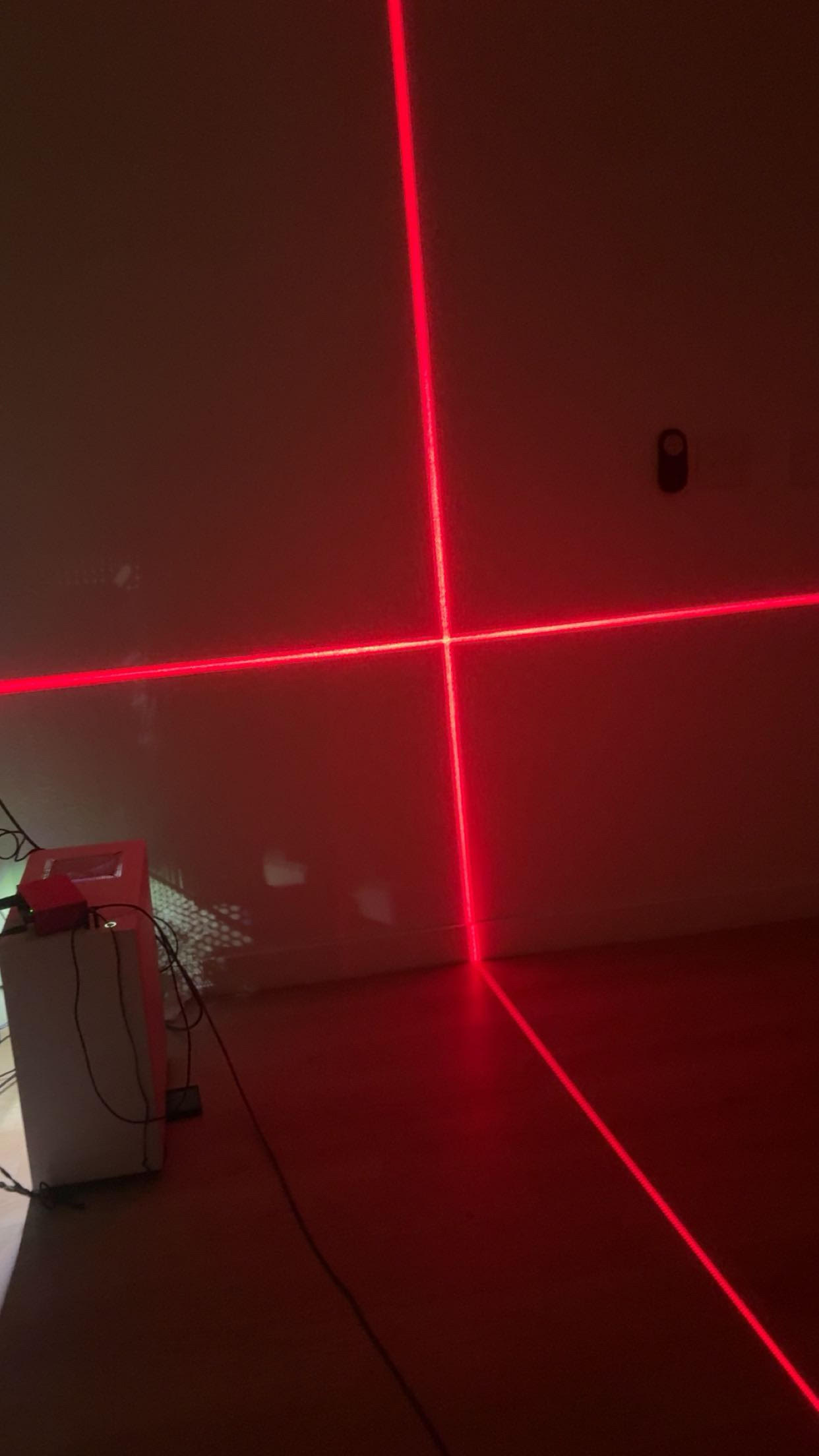
After 2 prior unsuccessful attempts, I was finally able to successfully view the code in the 650nm diffracted laser after breaking through on DMT from a vape cartridge. I took a total of six 5-second hits and broke through. Afterward, I was able to successfully focus my eyes on the code in the laser.
When I de-focused my eyes and looked "past/through" the warping effect in the laser caused by what I assume the DMT, I saw many lines of tiny matrix-style text/code 'executing' from left to right. It took me a total of about 10-15 minutes before I was finally able to focus on the code.
I could best view the code while sitting extremely still and focusing on one particular spot in the depth of the laser.
It seemed like the code was almost in the 'background' of the laser if that makes sense. I was able to perceive a 3d spacial-depth to the laser. The font size I would describe the code as is close to 1pt. I will focus on getting a better description for the style of the characters in my next viewing session.
Summary
The experiment documents a successful observation of code-like patterns within a diffracted 650nm red laser beam following a breakthrough DMT experience. The participant perceived matrix-style text moving within the laser projection, noting depth and focus points critical to viewing the phenomenon.
Key Findings
- •Successful post-breakthrough code observation required focusing beyond the laser diffraction.
- •Observed code movement from left to right, perceived as 'executing' text.
- •A distinct perception of 3D spatial depth perceived within the laser projection.
- •Clarity achieved through extreme stillness and focused observation.
- •Technical conditions included a 650nm, 1mW laser at a 5m projection distance.
Patterns Identified
Visual Patterns
- • Perception of tiny matrix-style text 'executing' left to right
- • Three-dimensional spatial perception within the laser projection
Behavioral Patterns
- • Requirement of stillness and focused observation for clarity
- • Focus beyond the immediate warping effect for code visibility
Technical Patterns
- • Utilization of a 650nm red laser, 1mW power
- • Cross-line laser module providing intersecting beams
Scientific Insights
Scientific Significance
The experiment suggests that the interaction of DMT and specific laser parameters may allow participants to perceive complex symbolic or text-like visual phenomena. This could contribute to an understanding of altered states of consciousness and their influence on visual perception.
Methodological Notes
The experiment lacks controls for variables like ambient lighting or user expectations. While the laser specifications are noted, it remains unclear how environmental conditions or exact DMT dosages impact observations.
Recommendations
Future experiments should include controlled settings for lighting and environmental factors. Additional documentation on participant prep protocols (e.g., focusing techniques) could enhance data reliability. Varying laser parameters and DMT doses systematically could further elucidate observed phenomena.
Image Analysis
Visual Elements Detected
Image Descriptions
Image 1
### Analysis of the Image 1. **Code-like Patterns:** - The image displays two prominent linear beams forming a cross. There are no distinct symbolic, geometric, or text-like structures visible within the light patterns that suggest sophisticated or intricate code-like designs. 2. **Visual Characteristics:** - **Colors:** The image predominantly features red due to the laser's wavelength (650nm), which falls within the red part of the spectrum. - **Light Diffraction Effects:** The light beams are sharply defined, indicative of minimal diffraction. The reflection shows consistent intensity, with edges slightly diffused as they interact with the wall surface. - **Pattern Density and Distribution:** The beams are dense and concentrated into linear patterns with roughly equal intensity along their paths. 3. **Structure and Organization:** - **Grid-like Formations:** The main visible pattern is the cross formed by the intersecting beams, suggesting a simplistic grid-like organization. - **Layering and Dimensional Qualities:** There is an apparent layering effect where the beams intersect, reinforcing the perception of depth without any evident 3D structure. 4. **Movement Indicators:** - There are no explicit indicators of motion or flow within the laser patterns. The beams appear stationary and stable. 5. **Surface Interactions:** - **Projection Surface:** The laser interacts with a flat, likely smooth surface, which contributes to the clarity and sharpness of the beams. The surface shows minor diffuse reflection, enhancing visibility without significant alterations to beam integrity. - **Additional Surfaces:** There are faint scattered reflections on adjacent surfaces, suggesting interactions that diffuse light but do not significantly alter the primary cross pattern. 6. **Overall Composition:** - **Spatial Relationships:** The cross formed by the lasers divides the image compositionally into quadrants, with the vertical and horizontal beams acting as dominant elements. - **Notable Features:** The precision of the intersecting beams stands out against the neutral background, emphasizing minimalistic design principles. Overall, the image captures a simple, orderly interaction between red laser beams and their environment, focusing on geometric clarity rather than complex patterns or movements.
This analysis is generated by AI and should be considered as supplementary insight. It does not replace professional scientific review or peer evaluation.
Images (1)
N,N-DMT
| Parameter | Protocol | Trial | Variance |
|---|---|---|---|
| Laser Wavelength | 650 nm | 650 nm | +0 nm (+0.0%) |
| Laser Power | 1 mW | 1 mW | +0.00 mW (+0.0%) |
| Substance Dose | 1000 mg | 70 mg | -930.00 mg (-93.0%) |
| Projection Distance | 1.5 feet | 5 feet | +3.5 feet (+233.3%) |
| Laser Class | Class 2 | Not specified | - |
| Substances | N,N-DMT 1000 mg | N,N-DMT 70 mg | - |
Additional Observers:
No
Except where otherwise noted, all content is licensed under a Creative Commons Attribution-ShareAlike 4.0 International License.