@Kevin Thorbahn
FacilitatorConducted: 2026-01-06
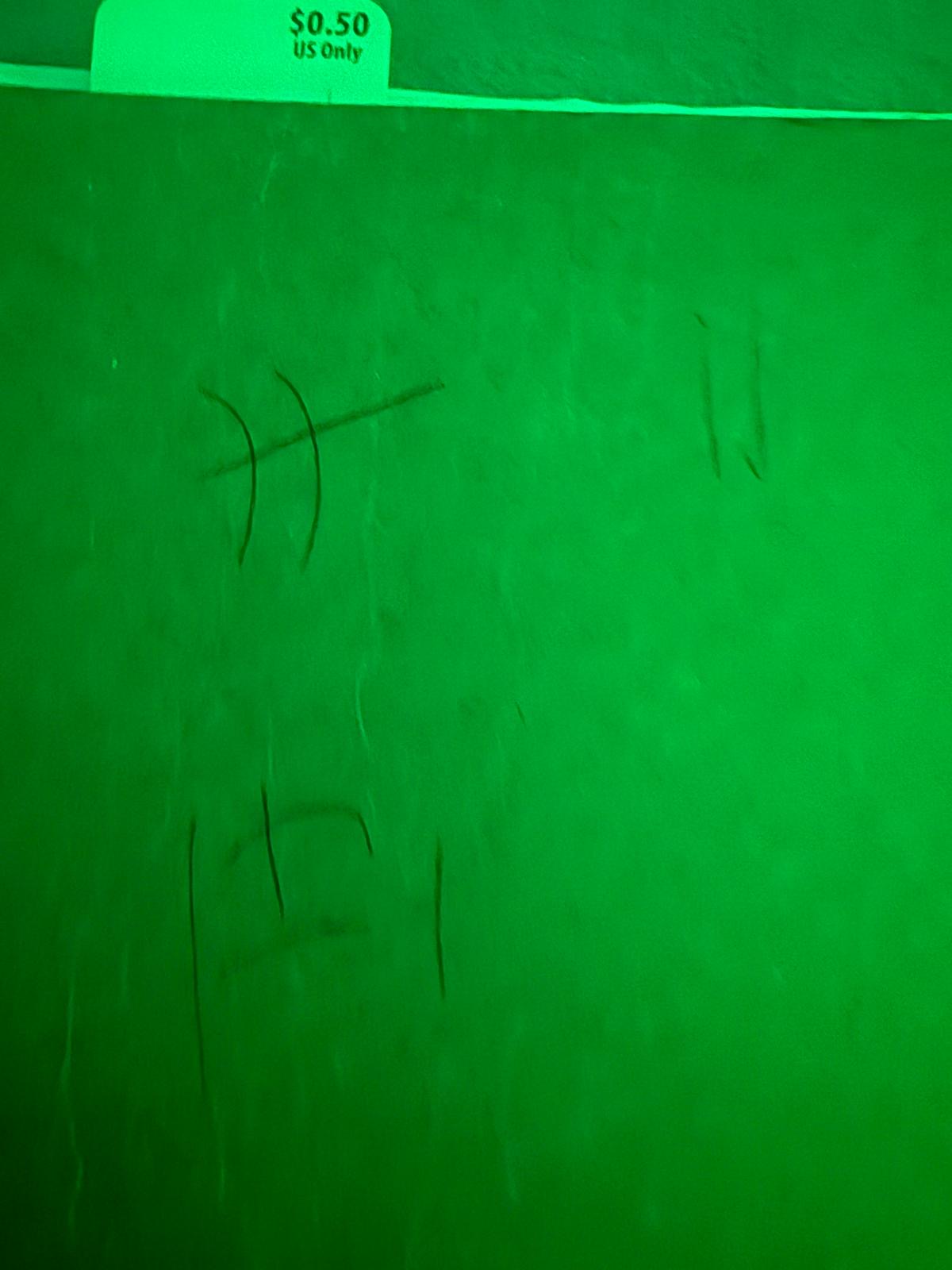
Adam described he saw Kanji like characters. He was at the end of a 3 hour DMTx session and running at .4-.8mg/min of dmt during the experience. Adam also was using a 700mg/ml dmt pen for boosters to stay in the ideal space to see the code. Adam stayed in this dmt state for 1 hour exploring the code. Adam saw the object permanence.
Summary
The experiment involved viewing laser-projected patterns under the influence of DMT during a prolonged, controlled session, with a focus on visualizing 'Code of Reality' elements evocative of symbolic characters and runes, primarily influenced by optical diffraction factors.
Key Findings
- •Participants reported viewing symbolic, Kanji-like characters under a DMT experience.
- •The red laser (650nm) produced sparse, linear patterns perceptibly scattered and filtered through green hues.
- •The diffracted patterns appeared stationary and unchanging over time, possibly due to surface uniformity.
- •Strong laser diffraction effects were noted with intersecting geometric patterns formed under controlled parameters.
- •Participants explored the subjective phenomenon of 'object permanence' within the altered state.
Patterns Identified
Visual Patterns
- • Kanji-like characters
- • Geometric intersections
- • Sparse, line-based patterns with green hue
Behavioral Patterns
- • Static and unchanged perception of patterns with prolonged viewing
- • Extended subjective engagement with perceived symbolic patterns
Technical Patterns
- • Use of a 650nm red laser producing diffraction artifacts on a flat screen
- • Projection distance of 5m creating minimal surface interaction effects
Scientific Insights
Scientific Significance
This experiment supports the theory that psychedelic experiences modulate visual perception through altered cognitive and sensory processing, evidenced by the interpretation of abstract patterns as symbolic or meaningful codes. The lack of motion perceived suggests potential neural mediation in identifying static imagery during hallucinogenic states.
Methodological Notes
The study maintained controlled DMT dosages and consistent environmental conditions, leveraging both direct entheogen administration and booster doses to sustain psychedelic influence. The descriptions remain heavily subjective; direct observational tools should be enhanced to reduce interpretative ambiguity.
Recommendations
Future studies should incorporate camera-based recordings of laser diffraction under varied wavelengths as participants view the phenomena to correlate direct physical observations with subjective reports. Increasing surface texture or using multiple projection surfaces might enhance interaction complexity and pattern variety.
Image Analysis
Visual Elements Detected
Image Descriptions
Image 1
Sure, let's analyze the image based on the specified aspects: 1. **Code-like Patterns:** - The image contains a few line-based, symbolic forms. These appear somewhat abstract and do not resemble conventional text or known symbols. - The patterns involve simple linear elements that could evoke runes or abstract symbols seen in diffractive interfaces. 2. **Visual Characteristics:** - The dominant color is a green hue, which suggests filtering or scattering affecting the original red laser light. - The lighting appears diffused, affecting the perception of sharpness and contributing to a spread-out pattern. 3. **Structure and Organization:** - The patterns are sparse and do not form dense clusters or a grid-like structure. - There aren’t distinct layers, indicating a relatively flat interaction with the surface. 4. **Movement Indicators:** - There are no obvious visual cues of movement or flow within the patterns captured. The lines and shapes appear stationary and fixed. 5. **Surface Interactions:** - Interaction with the surface is minimal in terms of reflection or refraction effects, as the marks are direct and simple. - The lack of complex diffraction suggests a relatively smooth and uniform surface without significant texture affecting scattering. 6. **Overall Composition:** - The spatial arrangement is open, with ample negative space, emphasizing the simplicity and isolation of each pattern component. - Notable features include the thinness of the lines and the randomness of their placement, suggesting a lack of deliberate alignment. This analysis is based on visual observation, focusing on characteristics like light behavior, color filtration, and pattern formations in this specific experiment setup.
Image 2
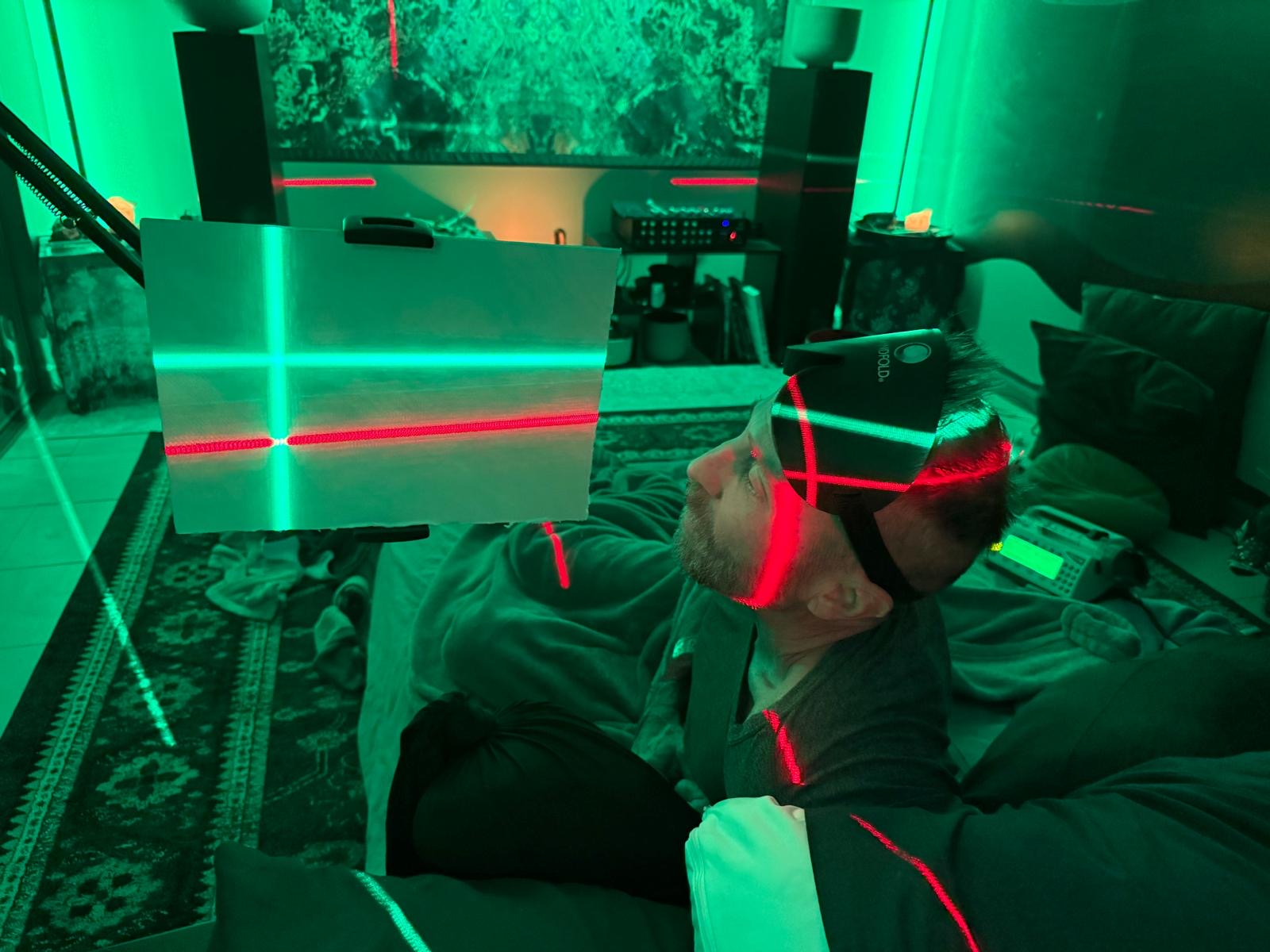
To analyze the image from a Code of Reality (COR) laser experiment, focusing on the specified elements: 1. **Code-like Patterns**: - No explicit code-like symbols or text are visible. - Geometric structures include intersecting light lines forming cross patterns. 2. **Visual Characteristics**: - Dominant colors are red and green. - The red laser (650nm) creates intense linear lines, crossing at various points. - Light diffraction effects are evident, creating sharp, bright lines. 3. **Structure and Organization**: - The laser lines form a grid-like pattern on the screen. - The arrangement suggests layering, with light intersecting at different angles. - Dimensional qualities are flat where the light interacts with surfaces. 4. **Movement Indicators**: - No evident visual cues of motion or flow are captured in this still image. - The static arrangement suggests a fixed projection. 5. **Surface Interactions**: - The laser interacts with a white screen, creating prominent cross patterns. - Some red laser lines are projected onto other objects, maintaining intensity. 6. **Overall Composition**: - The spatial relationship highlights a central interaction point on the screen, where the laser beams intersect. - The distribution is even, with intersecting lines providing a symmetrical layout. - Notable features include the clear, high-contrast laser lines against the surface. This analysis captures the structured, geometric organization and vibrant contrasting colors resulting from the laser setup. The lack of movement and distinct code patterns suggests a focus on static, organized diffraction effects.
This analysis is generated by AI and should be considered as supplementary insight. It does not replace professional scientific review or peer evaluation.
Images (2)
Videos (1)
3.89 MB
N,N-DMT
| Parameter | Protocol | Trial | Variance |
|---|---|---|---|
| Laser Wavelength | 650 nm | 650 nm | +0 nm (+0.0%) |
| Laser Power | 1 mW | 1 mW | +0.00 mW (+0.0%) |
| Substance Dose | 1000 mg | 250 mg | -750.00 mg (-75.0%) |
| Projection Distance | 1.5 feet | 5 feet | +3.5 feet (+233.3%) |
| Laser Class | Class 2 | Not specified | - |
| Substances | N,N-DMT 1000 mg | N,N-DMT 250 mg | - |
Additional Observers:
No
Except where otherwise noted, all content is licensed under a Creative Commons Attribution-ShareAlike 4.0 International License.